What Reforms to the Catholic Church Did Martin Luther and John Calvin Call for?
Martin Luther and Reformation – Catholic and Other Religions in Europe 1500-1600s
Martin Luther was built-in on November ten, 1483, in Eisleben, Saxony, Germany. Luther's begetter, a hard-working miner, wanted his son to exist a lawyer. So in 1501, Luther began studying law at the University of Erfurt and graduated with a BA in 1505.
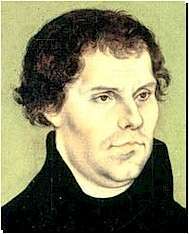
One day in 1505, Luther was caught in a thunderstorm and was thrown to the ground when a bolt of lightning struck nearby. Like most men and women of this time, Luther believed that God could come up to the aid of humans. In the storm, he cried out, "Help, St. Anne, and I will get a monk." True to his word, that same year Luther ceased studying constabulary and joined the monastery in Erfurt. Luther was a model monk, and in 1507 he has ordained a priest. A twelvemonth later, Luther was selected from amidst his peers to teach at the University of Wittenberg. As a monk Luther had struggled to understand the true nature of godliness. The church thought that the performance of religious ritual and good deeds was necessary to ensure the soul's salvation. Luther worked difficult to satisfy the church and salve his soul. Just he worried that his actions might not satisfy God.
Luther'southward fears vanished, however, when he read St. Paul's letter to the Romans: "He who through faith is righteous shall live." (Romans 1:17). To Luther, Paul'southward message seemed clear: the path to God is through faith alone, forgiveness was not something the church could grant, non was information technology something individuals could attain on their own. Instead, it was given by God to each person who accepted him. This theory became known every bit "justification past faith", significant that a person could be fabricated merely or good, by his or her organized religion in God.
Luther's belief in justification past organized religion led him to question the Catholic Church building'south practices of self-indulgence. He objected not only to the church'southward greed but to the very idea of indulgences. He did not believe the Catholic Church had the power to pardon people sins. Rather, Luther thought that salvation could be achieved merely through God's mercy. No 1 needed to seek or buy conservancy through the church building.
By nailing his theses to the church door, Luther was not acting similar a heretic. He was just inviting other scholars to respond to his ideas in a debate, an ordinary method of learning at universities of his days. At first, no ane accustomed Luther's invitation. Over the side by side few years, however, his Ninety-Five Theses sparked a religious movement to reform the Catholic Church building. Because the reformers were protesting against what they felt to be the abuses of the Cosmic Church, they came to be known as Protestants. And considering they wanted to reform the Catholic Church, that is, improve information technology by making changes, their motion is known every bit the Reformers.
Luther's Xc-Five Theses were soon translated from Latin into German. Within a year, his ideas were known throughout Europe. As one historian put it, they spread "…as if angels from heaven themselves had been their messengers." Encouraged by his success, Luther wrote hundreds of essays between 1517 and 1546, in which he stresses justification past faith and criticised church abuses. Finally, in 1520 Pope Leo X issued a balderdash – a statement of the Pope'due south authority – condemning Luther and banning his works. Defying the Pope, Luther publicly burned the bull. The break with the church was and so complete. In Jan 1521 Pope Leo Ten excommunicated Luther.
Meanwhile, through all this process, Luther explained all his Ninety-5 Theses and the reason for his objections. He showed the practices as proof of how greedy and decadent the Catholic Church had go. Luther challenged the church to ascertain itself – if information technology could. He read over one of his thesis: "Why does not the Pope, whose riches are at this twenty-four hours more than ample than those of the wealthiest of the wealthy, build one basilica of St. Peter'southward with his own money, rather than with that of poor believers?" Luther's Ninety-Five Theses were really an invitation to scholars to debate certain church bug. He had no idea that his challenge to the church would light a burn down of protest and change that would sweep across Europe, and crusade the reaction of Pope Leo 10 to excommunicate him from the Catholic Church building.
However, Charles Five, the Holy Roman Emperor, decided to give Luther 1 final take chances. In 1521 at a coming together of Worms, Federal republic of germany, the Emperor demanded that Luther recant, or accept back, his didactics. Facing church officials and an excited associates of people, Luther refused. He said in part, "I do not accept the authority of Popes and councils. My censor is convict to the word of God. I cannot and I volition non recant anything. Here I stand up, I cannot do otherwise.
God help me. Amen." A near-riot broke loose. Luther strode out, his hands raised in triumph. However the Emperor later on alleged him an outlaw whom anyone could kill without penalisation. Fortunately for Luther, he had a powerful friend in Frederick the Wise, Prince of Saxony. The Prince arranged a pretend to kidnap of Luther and hid him away for almost a year in the castle at Wartburg. Here, Luther translated the Bible from Greek into German. His translation allowed the Germans people to read the word of God without having to rely on the interpretation by the priest. Luther continued to write work in which he attacked the church or discussed books of the Bible. His instruction somewhen inspired a new Protestant organized religion called Lutheranism. This new faith would proceed to oppose the once all-powerful Cosmic Church.
Why did Luther's ideas, which challenged the centuries-erstwhile Catholic Church, succeed? Get-go, many people recognized the widespread corruption within the church and were eager for reform. Second, Luther wrote and spoke with conviction. His words were immensely highly-seasoned to the people. The printing press, developed in Europe almost 1450, besides contributed to Luther's success. Printed pamphlets containing unbound essays on current topics could spread new ideas quickly to many people. By 1523 about a one thousand thousand copies of Luther'south pamphlets were in apportionment. Every bit the Reformation spread, it gained the support of European peasants. In 1524 and 1525, arguing that everyone was equal under God, a group of poor German peasants took up arms confronting their wealthy landowners. Known as the Peasant War, this revolt was badly organized and lacked potent leadership. Government armies chop-chop crushed the uprising. The peasants were surprised and disappointed to discover that Martin Luther did non support them in the Peasant War. In the pamphlet chosen Against The Robbing and Murdering Hordes of Peasants Luther criticized the rebels for seeking economic proceeds in the name of God. As a outcome, Luther lost the support of many social reformers.
However, Luther's ideas became popular with the German princes. Luther did non believe that the church should own belongings. He also thought that rulers should appoint clergy members. Thus, Luther favoured a more than powerful office for rulers and weaker church building authorization. Many German princes who wanted liberty from the Pope'southward authority favoured Protestantism. Others remained Cosmic because they depended on the support of the Pope. Eventually, the differences between those German princes erupted in state of war. From 1546 to 1555, state of war raged between the Catholic and Protestant princes. Finally, in 1555, a compromise called the Peace of Augsburg, was reached. This compromise permitted each German prince to determine which organized religion would exist immune in his country. Most rulers of northern Deutschland chose Protestantism, and well-nigh in southern Federal republic of germany remained Catholic. Many people had to move to states that immune them to practice their own faith.
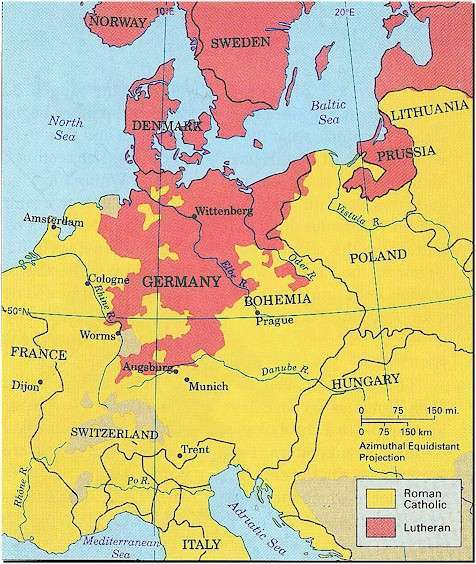
By 1560, the Reformation was established in Germany and, as you tin can see on the map above, in much of the rest of Europe.
In the early on 1500s reform spread throughout Europe. Three of Martin Luther's ideas became the center of the fence. 1 thought was justification past faith. The second was the thought that the Bible was the only authority for Christians, rather than the law of the Catholic Church building or Papal bulls.
The tertiary was a belief in a priesthood of all Christians denying the special powers that priests had in the Catholic Church. Around 1517 when Luther posted his Ninety-Five Theses, Ulrich Zwingli, a Swiss priest working in Zurich, brought the Reformation to that city. He urged Christians to study the Bible on their own and deepen their faith.
After Zwingli's death, John Calvin, a Frenchman educated in law, continued to teach the ideas of the Reformation. Forced to flee France in 1534 where the Catholic Church building had been harassing Protestants. Calvin moved to Switzerland. The city of Genoa soon became the heart for a motility chosen Calvinism.
Calvinism differed from other movements of the Reformation in i important mode. Calvin taught that God had already chosen, or predestined, a special grouping of believers for salvation. This theory is known as predestination. Luther also accepted predestination but idea that people could never know whom God had chosen.
Calvinism emphasized existence devoted to God and leading a disciplined life. According to Calvinists, a person who could maintain such conduct was probably a member of God's chosen group. Calvinist church services were manifestly. No images of saints hung on the walls; no organ accompanied the singing.
Nothing appealing to the senses interfered with what the worshiper experienced as his or her spiritual link to God. Calvinists also followed a strict lawmaking of moral behaviour. Laughing or making racket in the church building was prohibited.
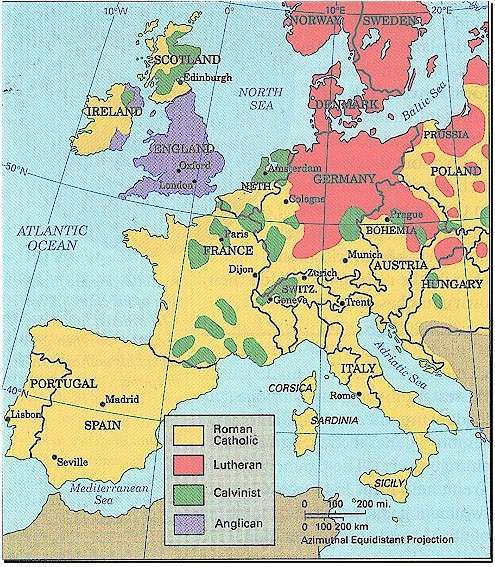
And then were fortune-telling, gambling, and even dancing at social gatherings. Councils elected by church members enforced this code of behaviour, as well as other laws of the Calvinist church. By the time Calvin died in 1564, Calvinism had taken root in Scotland, England, French republic, Italian republic, Bohemia, Poland, and the Dutch Netherlands.
One Protestant group chosen the Anabaptists, lived by an even stricter moral code than that of the Calvinists. The Anabaptist movement began in Zurich around 1525 amidst a grouping of dissatisfied followers of Zwingli. They believed that the state was made up of sinners.
Therefore, the Anabaptists believed, true Christians should withdraw from the state and form a separate community. Both Catholics and Protestants openly opposed the Anabaptists. They resented the Anabaptists claim that members of all other religious groups were sinners. Anabaptists were widely harassed, and many were executed. Those who survived fled to Poland and Holland.
Not all religious reform movements had religious causes. In 1533, Rex Henry VIII of England was excommunicated for divorcing his wife and marrying another woman. And then Henry set up a new church building – the Church of England.
In 1534 the English government recognised the monarch every bit the supreme caput of the new church. Although independent of the Pope, the English church building remained basically very similar to the Cosmic Church in its principles and practices.
Not until Henry's son Edward Half-dozen became king in 1547 did a Protestant faith proceeds a strong following in England. Although this reform movement had dissimilar behavior, they shared the same basic motivations: the desire to bring about changes in the church. And because those changes were not coming from within the church, the reformers created their own church.
During the 1400's many priests recognised that reform needed to be fabricated. They realised that selling indulgences was decadent, and they protested against such abuses. Reforms came slowly.
However, every bit more than and more people left the Cosmic Church to join the Protestant movement, Catholic leaders urged Pope Paul III to assemble a general council to discuss church reform. The Council of Trent, held from 1545 to 1563, set two main goals: to rid the church building of abuses and uphold traditional Cosmic beliefs. This movement within the church building became known as the Counter-Reformation.
To rid the church of abuses, the church likewise encouraged the founding of new orders or special religious groups. Many of these were modelled after the Gild of Jesus, founded by the Castilian priest named Ignatius Loyola in 1540.
Jesuits, as the members of the order were called, took vows of poverty and obedience. The Jesuits were noted for their educational and missionary works. They worked tirelessly, spreading Catholicism in other sections of the world, to the people of America, Africa, and Asia.
In addition to encouraging the spread of Catholicism, church officials tried to halt the spread of Protestantism. Their methods were often extremely harsh. For example, the official in Rome revived the Inquisition –a church courtroom to judge and convict heretics. However, this courtroom often driveling its power.
Many Protestants who appeared before it was tortured. Others were sentenced to death when they refused to change their beliefs. The church officials as well established the Index of Prohibited Books.
This list of banned books included books by Calvin and Luther. The Counter-Reformation helped to correct many church building cases of abuse. Nonetheless, it could not end the spread of Protestantism. Never again would a unmarried religion dominate Europe.
Compiled by Marko Marelich, Retired Mechanical Engineer, San Francisco, California United states of america, October 2005
robinsontheim2000.blogspot.com
Source: https://korcula.net/martin-luther-reformation/
0 Response to "What Reforms to the Catholic Church Did Martin Luther and John Calvin Call for?"
Post a Comment