Wooden swords and replica rifles: History buffs in Indonesia recreate battles to honour national heroes
Advertisement
Asia
Wooden swords and replica rifles: History buffs in Indonesia recreate battles to laurels national heroes
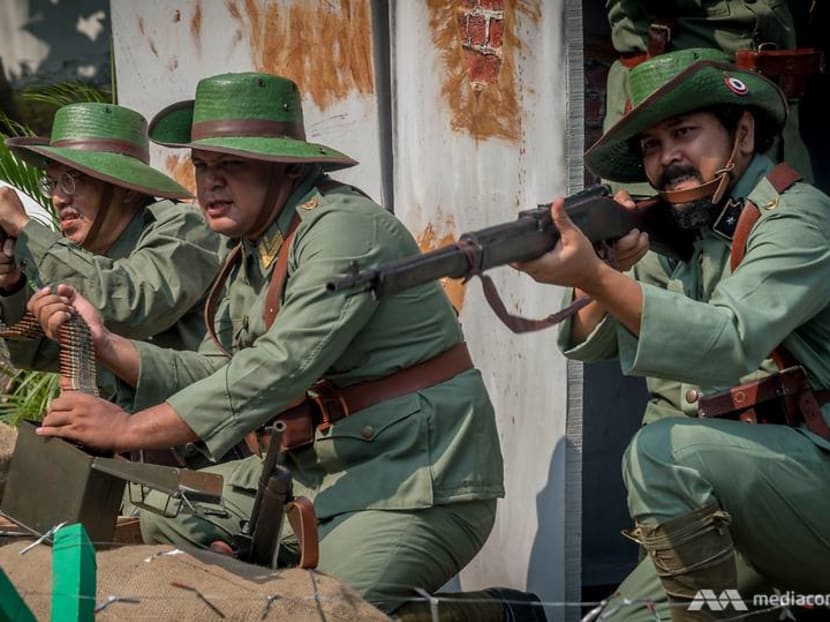
Indonesian re-enactors in Dutch Eastward Indies Army uniforms recreating a battle scene. (Photo: Nivell Rayda)

Djakarta: With a wooden exercise sword in paw and dressed in the manner of a World War II Imperial Japanese Army officeholder, Jasen Purwa Adi walked into a sun-broiled yard of an early 20th century home.
On the other side of the one thousand, a makeshift outpost fabricated out of plywood sheets had been erected, fortified past spinous wire fences and sand bags.
The outpost was guarded past seven men in Dutch E Indies Army uniforms and armed with replica rifles and a reproduction machine gun.
Adi and iii of his men may be outnumbered and outgunned, but within minutes, they seized command of the outpost and took their opponents as prisoners.
They were re-enacting the significant moments in the country's history, from the time the Dutch colonised Indonesia to the 1942 Japanese invasion, the subsequent 1945 declaration of Indonesia'due south independence and the bloody struggles to keep the Centrolineal Forces from reclaiming the country for holland.
About xl re-enactors - men and women of different ages and from dissimilar walks of life - participated in the re-enactment on Aug 1 at the Announcement of Independence Formulation Museum in Central Djakarta. The museum wanted to produce a video to commemorate Indonesia's Independence Day, which falls on Aug 17.

READ: Republic of indonesia to keep Independence Day celebration modest every bit COVID-19 rages
Some wore period-right civilian clothes while others dressed in armed forces fatigues of varying eras and countries.
To act out these scenes, some re-enactors had to play multiple roles.
1 re-enactor, Okie Rishananto, brought three sets of costumes that twenty-four hour period as he had to play a pre-World State of war 2 Dutch colonial soldier, a member of the Globe State of war Ii Centrolineal Forces troop and Indonesia's showtime vice president Mohammad Hatta.
"We tried to be as accurate every bit possible," the 44-year-quondam graphic designer told CNA, adding that re-enactors similar himself would obsess over tiny details of what fighters from different eras wore.
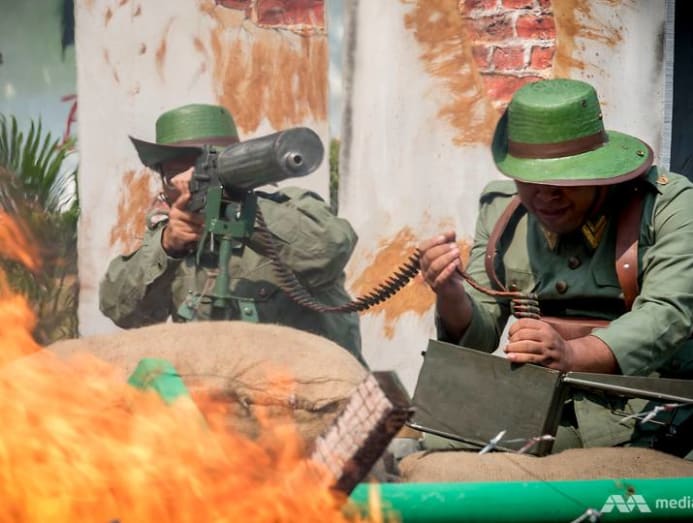
The starting time re-enactor community in Indonesia was started in 2003 and since then, similar communities across Republic of indonesia have sprung up. It is estimated that in that location are at present at least two,000 re-enactors in the country.
Rishananto said that the re-enactor customs in Jakarta gets together virtually every calendar month, peculiarly around anniversaries of famous battles, events or birthdays of historical figures.
Nearly of the re-enactments are private events amid the re-enactors, held in remote locations or private properties to go on bystanders with modern clothes abroad from the concluding photos or videos.
Yet, the community is ofttimes engaged by museums and urban center governments across Indonesia looking to phase re-enactments for the public to see equally part of their celebrations and events.
"The Yogyakarta authorities recently invited united states to stage re-enactment of their famous battle. They provided us with railroad train tickets, meals and a place to stay. Participants have to provide their own costumes, gear and props," he said.
APPRECIATION FOR COUNTRY'S HEROES
Being a re-enactor allows him to better appreciate the struggles of the land'south heroes, Rishananto said.
"Past re-enacting, you experience get-go hand the things that they went through. We get to experience their hardship, their tiredness and their hurting. These things were not mentioned in history books."
It is this appreciation which drives re-enactors similar Rishananto to portray the battles as accurately as possible.
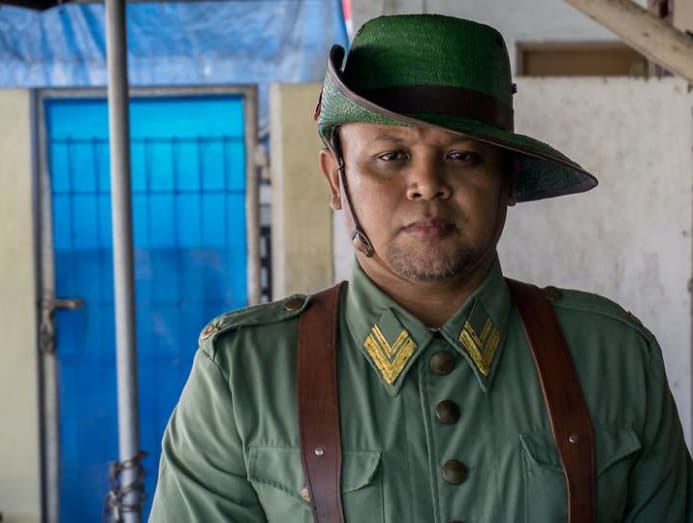
"You take to do your research. If you lot are recreating a specific battle scene then yous have to know exactly who were involved in it. Different branches of the military have different uniforms. Different divisions and units were issued unlike types of gear. Fifty-fifty if they were from the same country," he said.
Which is why it tin take upward to one yr to prepare one mock battle scene, another re-enactor Mohammad Iqbal told CNA.
READ: In Djakarta, an archaeologist races against time to preserve the city's 400-yr-old fortified walls
"We consult local historians, read history books, dig up old maps, newspapers, photos and so on. We even talked to people who were in that location at the time, including the Independence fighters who might withal exist alive," the 45-year-old said.
"We then establish how many re-enactors we need, what types of gear and uniform should we use and decide who gets to play what."
Simply there are re-enactments of amend known battles which crave less preparation. "Because we commemorate those battles every year, we spend less fourth dimension on enquiry," Iqbal said.
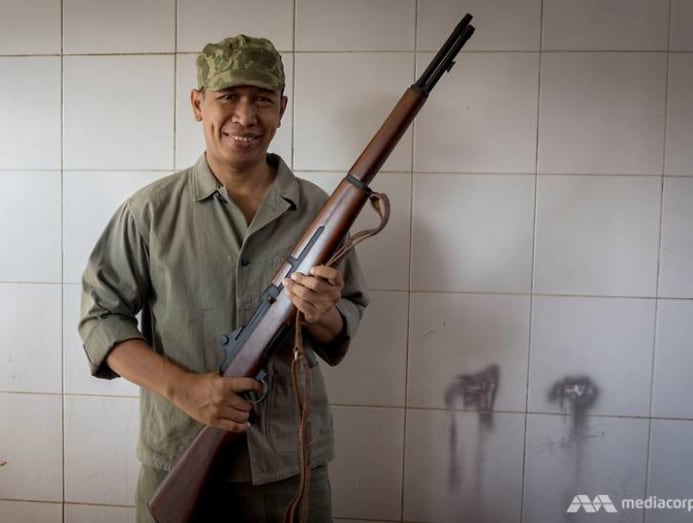
Iqbal said being a re-enactor is more than donning period-correct costumes and staging mock battles.
"Past becoming a re-enactor I become to talk to veterans who shared many of their personal stories. I get to find out that there was once a battle nearly where I alive and some other nearly my parents' hometown," Iqbal said.
"That is what makes me proud of beingness a re-enactor. Information technology gives more than values to the stories you heard or read in the history books. Information technology's more than than dressing up and wearing costumes."
OBSESSION TO DETAIL
For re-enactors in Indonesia, sourcing uniforms and gear proved to be a claiming, specially weapons which are illegal to own in the land.
"I have to custom make many of my uniforms, peculiarly those worn by American and British soldiers which are not readily available hither. If you are rich and then y'all can order one from their armed services surplus stores. Non us though," Iqbal said.
"Too, I prefer replicas over the existent matter. Past wearing replica uniforms you don't intendance if you take to crawl or roll over in the mud. It allows me to act out my scenes better."

To recreate one compatible, Rishananto said he had to expect at old black and white photos of the real thing.
"For example, the Dutch Due east Indies Army uniforms take their pockets aligned with the third push. Meanwhile Dutch soldiers during World War Ii would wearable the same uniforms as those worn past other members of the Allied Forces because their state was beingness occupied by Federal republic of germany," he said.
"Getting the colour and materials right is the hardest challenge of all, considering you can't tell past looking at old black and white photos."
Rishananto said he oftentimes goes to museums or talks to collectors to view the existent matter.
For the Aug 1 re-enactment at the museum, Rishananto brought two replica rifles, one fabricated to await like those used past the Dutch before the Japanese invasion and the other used during World War Two.
"Fighters from the two eras non only wore different uniforms only also carried different types of pouches, belts and water canteens. "Even the bullets they used were different," he said.
Meanwhile, Adi preferred to gild his replica uniform from Japan. "Even though this is a replica, information technology is made from the same material as the real thing and sewn the exact same fashion," he said adding that the rest of his gear is locally made.
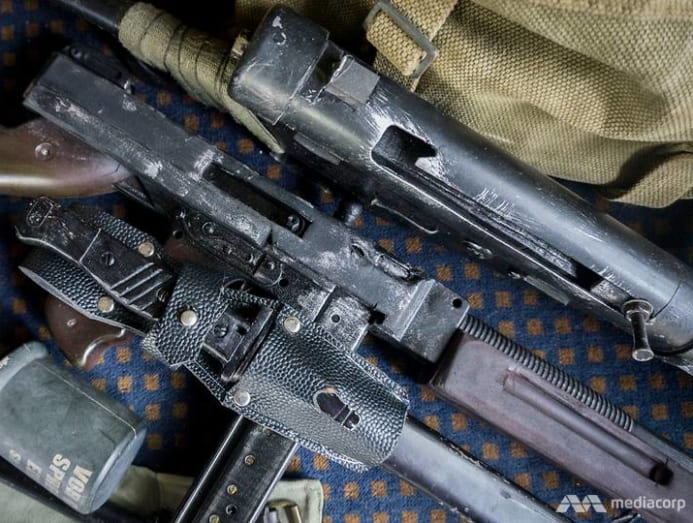
"I would prefer to accept everything locally made but for uniforms, none came close to the quality as those made in Japan."
Adi said his helmet is 18-carat, salvaged past locals from a dead Japanese soldier in Due south Sumatra. His helmet, he claimed, is haunted.
HOW IT ALL BEGAN
Re-enactment in Republic of indonesia is fairly new, said Rishananto, who was among the first re-enactors in Indonesia.
Inspired by movies similar Saving Private Ryan and the goggle box series Ring of Brothers, Rishananto, who has always been a military history buff, began sharing photos of himself posing as Globe State of war Two soldiers on Friendster in the early 2000s.
"The photos generated many praises but also many critiques also. Some said: 'This is inaccurate, this gear is not of the catamenia,' and and so on. I replied: 'How do yous know all this?' and they said they also accept similar costumes and gear," he said.

"And then we all got together to share information and showed off our collections. In that location were merely x of us back and then. Then i of us had this idea: 'Why don't nosotros re-enact some battle scenes.' Re-enactors take been around in other countries since the 1960s but at the time none of the states knew what re-enactors were."
READ: Forgotten heroes - Indonesian independence war veterans fall on hard times
The birth of the re-enactment scene in Indonesia likewise coincided with the craze on airsoft guns in the early 2000s, re-enactor Sonny Cavalera said.

"In the globe of airsoft, there is this matter chosen 'geardo' which is to apparel in the style of the military units which utilise the blazon of weapons nosotros own. That's how I became introduced to these history enthusiasts and that'due south how I joined," he said.
"I like history, but it is more fun to learn history past recreating it, specially in places where such historical events occurred."
Immature PEOPLE ALSO Drawn TO RE-ENACTMENTS
Re-enactment is not only bonny to the heart-aged.
At the Aug i outcome, nearly half of the re-enactors were in their teens and 20s. In that location were even two boys playing the roles of children from the 1930s and 1940s.
High school pupil Russell Alexander Yim, 16, said he had but been re-enacting since January later existence introduced to the community by a friend.

"There's a sense of community. You get to encounter people who are interested in the same things and hang out with them. Being a re-enactor gives me a driving passion to research more than. I have a better appreciation for our history now," he told CNA.
Vanial Kurniawan, 19, said she participated in a three-day re-enactment of a battle in Yogyakarta in February.
Kurniawan had to walk from one village to the next to act out her scenes. During breaks, she and other re-enactors from across Indonesia ate nothing but cassava and corn, but as local fighters would at the time.
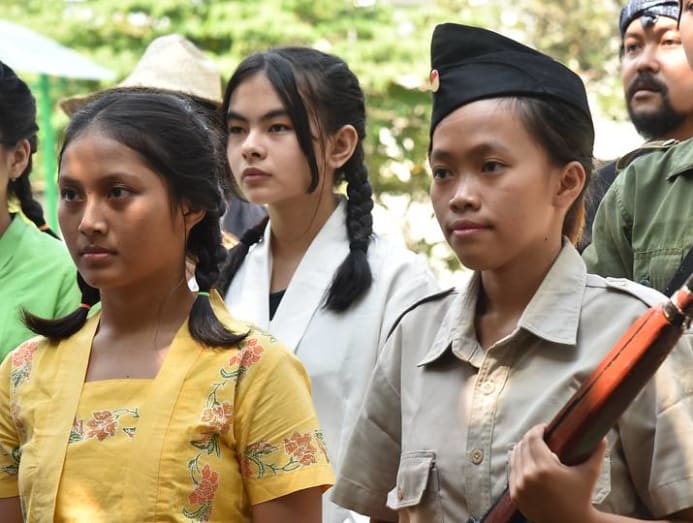
"I became and so emotional I burst into tears. I wondered, is this what it was like back then? These fighters were willing to shed their blood, sweat and tears for our state. The experience made me enquire myself what young people like me have done for our country," she told CNA.
College student Adi as well took his involvement in re-enactments seriously. He had been consulting World War II-era Japanese military manuals and guideline books and so he could learn the proper way of putting on his chapeau and helmet and tying his leg bindings.
The 21-year-old fifty-fifty learned a few Japanese military phrases and commands and so he could act out his scenes properly.
Cavalera, the 43-year-old re-enactor who is an airsoft enthusiast, said he is happy that younger generations are besides taking office in historical re-enactments. "I desire young people to likewise learn about our history and our independence, which was fought with blood and tears," he said.
robinsontheim2000.blogspot.com
Source: https://cnalifestyle.channelnewsasia.com/asia/wooden-swords-and-replica-rifles-history-buffs-indonesia-recreate-battles-honour-national-heroes-243286
0 Response to "Wooden swords and replica rifles: History buffs in Indonesia recreate battles to honour national heroes"
Post a Comment